
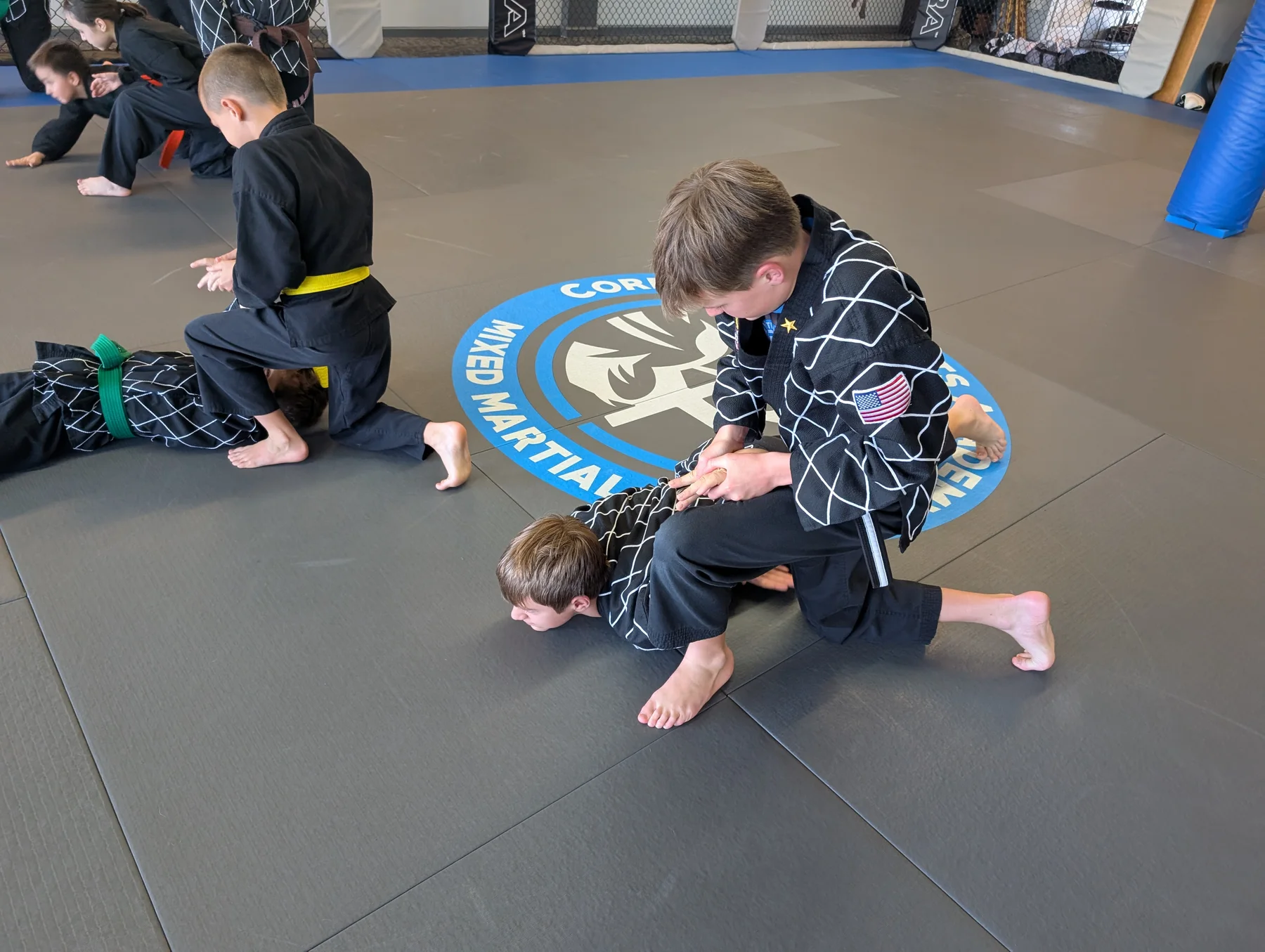
If you live between Pensacola and Navarre, you have no shortage of martial arts options. Drive Gulf Breeze Parkway or Navarre Parkway and you'll pass karate, taekwondo, jiu-jitsu and self-defense schools within a few miles of each other. That's good news for families, but it also makes the choice harder. The style on the sign matters less than most parents think. What matters is the program, the instructor, and whether your child will want to come back next week.
Here's how we'd suggest thinking it through, from a school that teaches kids from age 4 in Gulf Breeze.
Start with your child's age, not the style
Different ages need different classes, and a good school will separate them.
Ages 4–6. At this age, the real goals are listening, balance, coordination, taking turns, and having fun in a structured setting. Be skeptical of any program that promises a four-year-old will "defend themselves." Classes should feel like organized, purposeful play. (In our Kid Ninjas class for ages 4–8, that's exactly how we teach.)
Ages 7–9. This is where many kids can start holding onto techniques, following multi-step instructions, and controlling their bodies for a full class. Skills and self-control start to build on each other.
Ages 10–13. Older beginners aren't late. They usually bring longer attention spans and their own motivation, and they can handle more detailed self-defense concepts like awareness, boundaries, and escaping grabs. That's the focus of our Junior Self-Defense program for ages 8–13.
Ask how contact is introduced
The American Academy of Pediatrics' parent site advises that "when first getting started with martial arts, it is important to focus on non-contact form and skill development before considering any 'sparring' or contact," and that kids can be introduced to testing skills against others after they can perform them adequately (HealthyChildren.org). The same guidance says MMA "should be generally discouraged for young participants" (HealthyChildren.org).
So ask directly: When does my child first do any partner contact? Who supervises it? Are kids matched by size and experience? A confident answer is a good sign. A shrug is not.
Eight questions to ask before you sign anything
Local parents have said online that some schools won't share prices until after a tour (r/Pensacola). You shouldn't have to guess. Ask every school the same questions:
- What is the total monthly cost?
- Are there belt-testing fees, and how often are tests held?
- What uniform or gear is required, and do I have to buy it from you?
- Is there a contract? How long, and how do I cancel?
- Can I watch a full kids' class before my child tries one?
- Who teaches the kids' classes — the head instructor or assistants? What's their background?
- How do you handle a child who's shy, struggling, or having a rough day?
- What does "self-defense" mean in your kids' curriculum — techniques only, or awareness and avoidance too?
Write the answers down. Comparing three schools side by side usually makes the decision obvious.
What a good trial class looks like
When you watch a class, look past the kicks and at the room.
- Kids are moving most of the time. Long lines and lectures lose young students fast.
- The instructor knows names and gives quick, specific corrections.
- Rules are clear and consistent. Respect, listening, and safe partner work are enforced kindly but firmly.
- Mats and gear are clean and in good shape. The AAP guide notes that foam mats in non-contact programs "should be kept in generally good condition and cleaned to help prevent the spread of infection" (HealthyChildren.org).
- Progress is earned. Belts should reflect real skill and effort, not a calendar.
Afterward, ask your child one question: "Do you want to go back?" Their answer tells you a lot.
Real-world self-defense for kids means more than techniques
For kids, the most useful self-defense skills happen before anything physical: noticing what's going on around them, using a strong voice, setting boundaries, knowing when to walk away and who to tell. Physical skills — escaping a grab, keeping balance, falling safely — come next, and they're taught with responsibility attached. At Core, we teach kids that their skills are for protecting themselves and others, never for showing off. You can read more about how we approach bullying in our post on kids' safety and bullying in Gulf Breeze and Navarre.
Think about logistics honestly
The best program is the one your family can actually get to. If you're in Navarre, a school near Tiger Point can be an easy drive on the way home; if you're in Pensacola, cross the bridge at rush hour once before committing. Look at class times against school pickup, practice schedules and work. Two classes a week you'll actually attend beat four you'll skip.
How Core does it
Core Martial Arts & Self Defense is at 3483 Gulf Breeze Parkway in the Tiger Point area. Our kids' programs are:
- Kid Ninjas (ages 4–8): Mon/Wed 4 PM — coordination, focus, listening, and beginning self-defense through structured play.
- Junior Self-Defense (ages 8–13): Mon/Wed 5 PM and Tue/Thu 4 PM — awareness, confidence, and practical skills drawn from Krav Maga and Hapkido.
Our owner and chief instructor, Scott Farley, is a 4th Dan Hapkido master instructor, a 5th Dan Krav Maga master instructor, a U.S. Air Force veteran with a background in criminal investigation and personal security, and a Navarre resident since 2001. He's trained for more than ten years with Moshe Katz's Israeli Krav International.
The easiest way to see if we're a fit is our 2-week trial for $29.99. Come watch a class, ask us any of the eight questions above, and decide with full information. Call (850) 585-0950 or start your trial.
Awareness. Confidence. Capability. That's what we want every kid to leave with.