
Start with connection.
Your child seems quieter after school. A group-chat notification changes their mood. Suddenly, they don’t want to ride the bus.
For parents, one of the hardest parts of keeping children safe is knowing what happens when you aren’t there—and whether your child will tell you when something goes wrong.
Those worries are common. Pew Research Center reported in 2023 that 35% of U.S. parents were extremely or very worried about their children being bullied.[1] Helping children feel safer begins with open communication, dependable adults, and opportunities to develop confidence and practical skills.
This guide is for Gulf Breeze and Navarre families. Core’s children’s classes take place at our Tiger Point academy, 3483 Gulf Breeze Parkway, Gulf Breeze.
How can I tell if my child is being bullied?
Children may hesitate to tell an adult because they feel embarrassed, fear retaliation, or think speaking up will make things worse.
Watch for unexplained injuries, damaged belongings, sleep problems, frequent stomachaches, school avoidance, or withdrawal from friends. These changes can have other causes, and some children show no obvious signs. Begin with a conversation rather than an assumption.[2]
Instead of asking only “How was school?” try:
- “Who did you spend time with today?”
- “Did anyone make you feel uncomfortable or unsafe?”
- “Is anything happening in your group chats that you wish would stop?”
Give your child time to answer. If they share something upsetting, thank them for telling you, reassure them that bullying is not their fault, and explain that you will help.[4]
What should my child do about physical bullying?
Pushing, hitting, tripping, grabbing, or threats deserve adult attention. Help your child rehearse a simple plan: create distance, move toward safety, and get help. If speaking feels safe, they can say “Stop” or “Don’t touch me.” Otherwise, they can leave without speaking. StopBullying.gov recommends moving away, seeking adult help, and avoiding fighting back.[3]
Make the plan specific: which teacher can they approach, where can they go at lunch or recess, and who can help on the bus?
Record dates, locations, witnesses, and injuries. Contact the school and ask for concrete protections, a dependable adult contact, a reporting process, and a follow-up date. Keep following up; children should not be left to resolve bullying alone.[4]
If your child faces immediate danger or a serious injury, get emergency help.
What if it happens online?
Bullying can follow children home through games, group texts, messaging apps, and social media. In a 2022 Pew survey, 46% of U.S. teens ages 13–17 reported at least one of six forms of cyberbullying, including offensive name-calling, false rumors, or physical threats.[1]
- Listen calmly and thank your child for telling you.
- Save evidence of abusive text, including usernames and dates.
- Report the behavior through the platform and block the account.
- Discourage retaliatory replies or sharing hurtful content.
- Involve the school when classmates are involved or school safety is affected.
Discuss games, apps, and privacy settings regularly.[5] Avoid making loss of phone access the automatic result of asking for help; fear of losing contact with friends can discourage disclosure. Explain changes and involve your child in the plan.[6]
How can I build my child’s confidence?
Give children manageable chances to ask questions, make appropriate choices, and work through challenging activities with support. Recognize specific effort: “You felt nervous, and you spoke up anyway.”
Practice boundaries at home. Saying “No,” asking someone to stop, and seeking help should feel familiar. A confident child can still be bullied; quiet or frightened children deserve the same protection. The goal is to help children trust their boundaries and know support is available.
Can martial arts help?
A well-taught program offers repeated opportunities to practice focus, movement, self-control, and persistence. The American Academy of Pediatrics describes potential benefits including improved fitness, movement and thinking skills, and reduced stress. Benefits depend on the child and type of training.[7]
Ask how a class puts those lessons into practice. Do students listen, make decisions, control their movements, and work responsibly with partners? Look for progressive instruction and close supervision.
Kid Ninjas
An introduction to martial arts, confidence, coordination, focus, and age-appropriate personal safety.
Explore Kid Ninjas →Junior Self-Defense
Practical defensive skills, awareness, discipline, and controlled partner training for growing students.
Explore Junior Self-Defense →Tournament training and practical self-defense.
Tournament training prepares students for a sport’s rules. Depending on the discipline, that can mean judged routines, point scoring, or competition with permitted techniques and officials. It can build timing, balance, conditioning, composure, and meaningful goals.
Practical self-defense emphasizes recognizing trouble, responding appropriately, and reaching safety. An everyday confrontation has no referee. General personal-safety guidance emphasizes avoiding confrontation, escaping when possible, and getting help.[8]
For children, look for instruction in:
- Recognizing unsafe behavior and personal boundaries.
- Using a clear voice and asking for help.
- Creating distance and finding a way to leave.
- Practicing age-appropriate responses to unwanted contact.
- Reaching a trusted adult and reporting what happened.
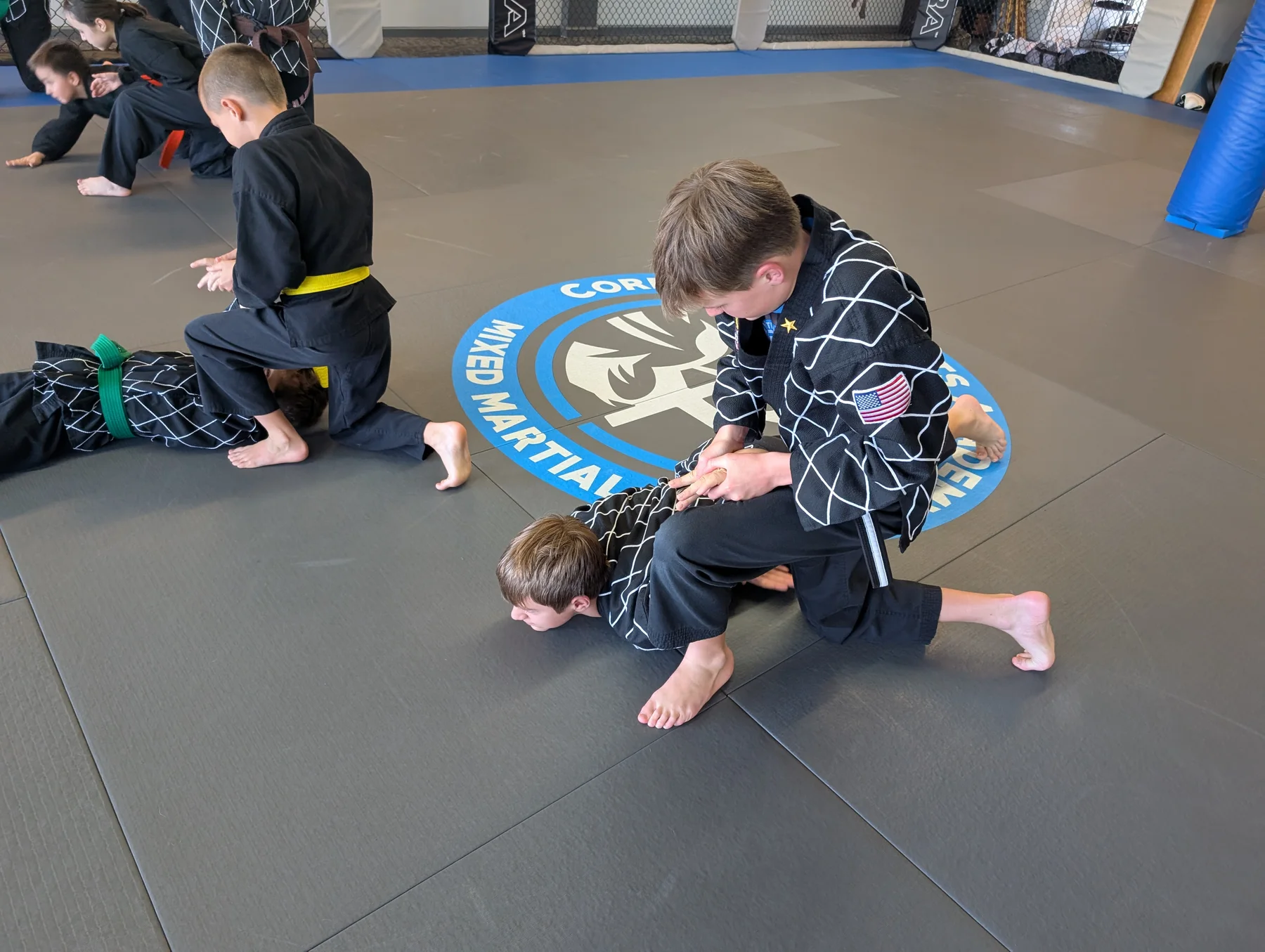
A school may teach both sport and self-defense effectively. Ask: “How do you teach a child to respond when someone threatens them, grabs them, or blocks their way?” Look for judgment, escape, and adult help alongside physical skills. Core’s Junior Self-Defense curriculum includes awareness, practical defensive skills, and controlled partner training.
What if my child is shy or new to training?
Explain what the first class involves, tell the instructor about concerns, and encourage questions. Notice small steps: joining an activity, trying an unfamiliar movement, or speaking to the instructor. Core welcomes beginners and introduces skills progressively at an appropriate pace.
What can our family do this week?
- Identify trusted adults your child can approach.
- Rehearse a short response to unwanted behavior.
- Review online reporting and blocking tools together.
- Make time for a calm conversation without distractions.
- Offer a challenging activity with encouragement.
If distress continues or affects school, friendships, or daily life, involve a school counselor or pediatrician.[9] Martial arts can complement that support while adults continue addressing the bullying itself.
For broader guidance on awareness, distance, and family safety, read the Gulf Breeze Family Self-Defense Guide.
“You deserve to feel safe. You can tell me what happened, and I will help.”
Sources and further reading.
- Pew Research Center: 9 facts about bullying in the U.S. (2023) ↗
- StopBullying.gov: Warning signs for bullying ↗
- StopBullying.gov: What kids can do ↗
- StopBullying.gov: Support the children involved ↗
- StopBullying.gov: Prevent cyberbullying ↗
- Australia’s eSafety Commissioner: How to help someone deal with cyberbullying ↗
- American Academy of Pediatrics / HealthyChildren.org: Martial arts for kids ↗
- New Zealand Police: Keep safe when out and about (general safety guidance) ↗
- American Academy of Pediatrics / HealthyChildren.org: Bullying guidance for parents ↗